Experience the benefits of balanced piano study—get your free Czerny sheet music today!
Introduction
For pianists, studying the pedagogical pieces of Carl Czerny is an essential part of their musical education. Czerny, a student of Ludwig van Beethoven, is renowned for his extensive contributions to piano pedagogy. He composed hundreds of exercises and etudes. Many of them are still widely used today to develop technical skills. These exercises also prepare students for more advanced repertoire, including the works of Beethoven himself.
While Czerny’s works are sometimes criticized for being mechanical, they actually offer significant musical value and versatility in teaching. I have found his Opus 823, “The Little Pianist,” particularly effective for my beginner students. They are interested in Classical music. These pieces often resonate more with students than the selections found in many modern method books.
Still, one notable limitation in Czerny’s approach is the exclusive use of the treble clef in the earliest exercises. This limitation is shared by many of his contemporaries. In Opus 823, for example, the first piece that introduces bass clef notes does not appear until number 41. This means that students who follow the original sequence do not get enough practice reading bass clef early on. By the time the bass clef is introduced, students have already learned techniques like Alberti bass. They have also learned two-note slurs, sixteenth notes, and accidentals. These could have been practiced in both clefs from the beginning.
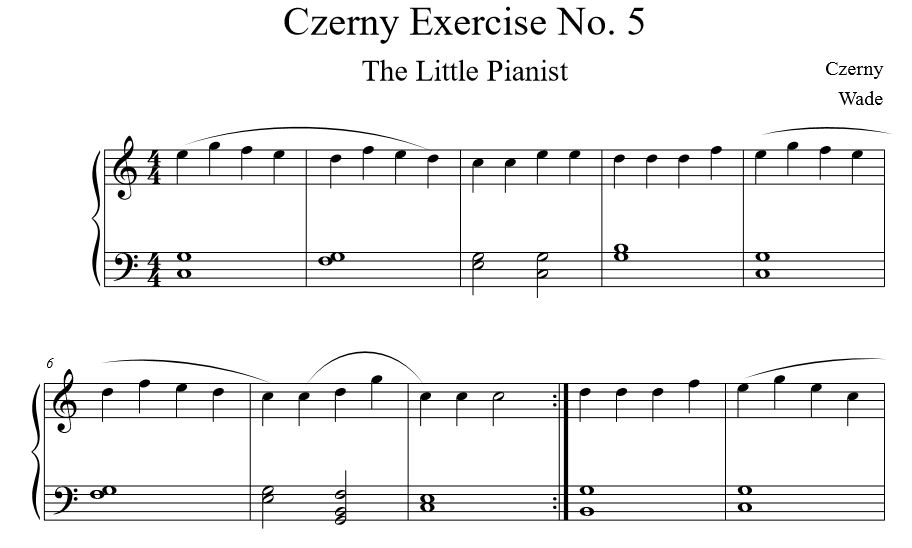
To fix this gap, I have started rearranging these pieces. The rearrangement includes both treble and bass clef notes from the outset. This approach helps students become confident and fluent in reading both clefs, supporting a more balanced technical foundation.
Today, I am pleased to share a free download of my rearrangement of Piece No. 5 from Czerny’s Opus 823. I hope this resource will help students and teachers. It aims to build strong reading skills. Additionally, it encourages a love for Classical repertoire.
To download
Unlock your free Czerny arrangement—download Piece No. 5 from Op. 823 now! To download, simply follow this link. I only ask in return that you link back to my page or otherwise properly give credit if you use.
Curious about lessons or have questions? Contact us to learn how we can support your musical journey!
About Czerny
Carl Czerny (1791–1857) occupies a unique place in piano history as a bridge between the Classical and Romantic eras. He was born in Vienna. He began piano studies with his father. Later, he became a student of renowned late Classical composer Ludwig van Beethoven. By age 15, Czerny was already teaching in Vienna. Among his most famous pupils was Franz Liszt. Liszt would become one of the greatest pianists of all time. Czerny’s influence extended far beyond his own studio. His progressive teaching methods became foundational in conservatories and music academies across Europe. His technical exercises stay integral to piano education today.
Czerny’s legacy is not limited to technical drilling. While he is best known for his vast output of etudes and exercises. He published nearly 1,000 works, including the School of Velocity and The Art of Finger Dexterity. His music also emphasizes musical expression, phrasing, and the stylistic nuances of both Classical and early Romantic repertoire. His teaching philosophy focused on incremental learning. He built a solid technical and musical foundation. This prepared students to tackle more complex works with both skill and artistry.
Benefits of Integrating Czerny’s Exercises with Other Repertoire
Blending Czerny’s studies with a variety of piano repertoire offers several key benefits for students and teachers:
- Comprehensive Technical Development: Czerny’s exercises systematically cover a wide range of technical skills—scales, arpeggios, finger independence, articulation, and more. Integrating these with other pieces ensures that students develop a well-rounded technique applicable to all styles.
- Musical Context and Application: Students should practice Czerny’s etudes alongside real repertoire. This helps them see how technical skills apply directly in musical contexts. This approach reinforces the idea that technique serves musical expression.
- Problem-Solving: If a student encounters a technical challenge in a piece, teachers can choose a Czerny etude. This will specifically address the issue. This approach accelerates progress and builds confidence.
- Sight-Reading and Pattern Recognition: Czerny’s exercises often highlight common patterns found in piano music. They improve students’ sight-reading and overall musical literacy.
- Preparation for Advanced Works: His progressive approach methodically prepares students for more demanding repertoire. This includes works by Beethoven, Chopin, Liszt, and beyond.
Historical Context: Why Czerny Matters
Czerny experienced a pivotal era in music. He observed the transition from Mozart’s Classical style to the expressive heights of Romanticism. As Beethoven’s pupil, he was uniquely positioned to absorb and convey the evolving demands of piano technique and musicality. His teaching shaped generations of pianists, with his influence passing through Liszt and onward to countless others. Czerny’s meticulous approach to both technical mastery and expressive playing set a standard that endures in piano pedagogy today.
By integrating Czerny’s exercises with a diverse repertoire, students and teachers can build a strong, versatile foundation. This foundation honors both the technical and expressive dimensions of piano playing. This is just as Czerny himself intended.
Want more resources like this? Sign up for our newsletter to get exclusive updates and downloads.
Sources:
- https://robertgreenbergmusic.com/music-history-monday-what-would-we-do-without-him/
- https://practisingthepiano.com/czernys-exercises-and-etudes/
- https://kids.britannica.com/students/article/Carl-Czerny/320870
- https://lvbeethoven.com/legacy-of-carl-czerny-beethovens-pupil-eminent-composer/
- https://www.youtube.com/watch?v=EFAuZjjjti0
- https://www.florencephillipsmusic.com/2023/07/02/who-was-carl-czerny/
- https://www.pianistmagazine.com/blogs/3-reasons-why-you-should-study-czerny-exercises/
- https://www.hanon-online.com/biography-of-carl-czerny/
- https://pianofantasy.com/the-magic-of-czerny-etudes-for-the-piano/
- https://colourfulkeys.ie/piano-studio-website/
- https://interlude.hk/on-this-day-21-february-carl-czerny-was-born/
- https://www.ashleejyoung.com/blog/5-things-you-need-to-know-to-practice-czerny-on-the-piano
- https://en.wikipedia.org/wiki/Carl_Czerny
- https://exhibitions.lib.umd.edu/piano-genealogies/pianist-bios/czerny-tradition
- https://pianosyllabus.com/x-detail.php
- https://www.pianostreet.com/smf/index.php?topic=52043.0
- https://www.pianostreet.com/smf/index.php?topic=35163.0
- https://forum.pianoworld.com/ubbthreads.php/topics/2432038/Learn_from_repertoire_or_etude.html
- https://www.youtube.com/watch?v=rWfm8bGW2nQ
- https://www.hanon-online.com/biography-of-carl-czerny-2/
- https://livingpianos.com/en/are-czerny-and-hanon-a-waste-of-time/
- https://www.reddit.com/r/piano/comments/d1sc05/czerny_hanon_and_others_waste_of_time/
- https://www.growyourmusicstudio.com/guide/fb-guide-growyourmusicstudio.pdf
- https://www.youtube.com/watch?v=Tgvivj8XaVg


Leave a Reply